


A Bankable Storage Ecosystem Needs Better Market Design, Local Manufacturing
India must focus on domestic manufacturing, stronger monetization and supply chain development
July 2, 2026

Follow Mercom India on WhatsApp for exclusive updates on clean energy news and insights
India’s battery energy storage market will require stronger market design, phased domestic manufacturing, better monetization mechanisms, and continued policy support to build a bankable ecosystem capable of supporting the country’s renewable energy expansion, panelists said at the Mercom India’s Renewable Energy Summit 2026.
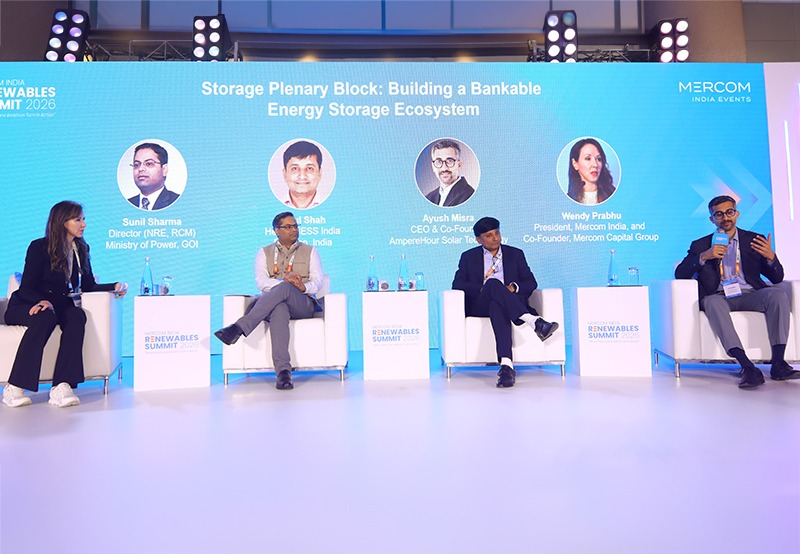
The plenary session, titled “Building a Bankable Energy Storage Ecosystem,” was moderated by Wendy Prabhu, Co-Founder of Mercom Capital Group. It featured Sunil Sharma, Director (NRE, RCM) at the Ministry of Power; Vipul Shah, Head, BESS India at Envision Energy India; and Ayush Misra, Chief Executive Officer and Co-Founder at AmpereHour Solar Technology.
Opening the discussion, Prabhu noted that India has installed over 150 GW of solar capacity, while battery energy storage deployment remains comparatively small. She said the mismatch between renewable energy additions and storage deployment highlights the need for large-scale storage to improve grid stability, reduce curtailment, and integrate higher shares of renewable energy.
Sharma said India has about 8.5 GWh of installed battery energy storage capacity and that battery storage has only recently become commercially viable as costs have declined.
He said storage demand will be driven by two major segments. The first is public procurement, with distribution companies procuring storage as part of resource adequacy planning and flexibility requirements. The second is the commercial and industrial segment, where growing open access adoption and tighter banking regulations are expected to increase demand for solar paired with storage.
Sharma said resource adequacy studies project India’s storage requirement to exceed 800 GWh by 2035, with battery energy storage accounting for roughly 350 GWh. The medium-term requirement exceeds 200 GWh by 2032.
On manufacturing, Sharma acknowledged India’s dependence on imported battery materials and cells but said the government is working to strengthen domestic manufacturing across the battery value chain.
He said current efforts extend beyond advanced chemistry cells to upstream materials such as cathodes, anodes, electrolytes, and separators. The government is also encouraging domestic manufacturing of battery packs and containerized systems through phased domestic content requirements.
Shah said India must build a sustainable market ecosystem for battery storage through policy and regulatory clarity, grid planning, transmission development, and domestic manufacturing.
He said localization should follow a phased approach. In the first phase, India can focus on localizing storage components other than cells, since cell manufacturing is capital-intensive and requires technology depth. Cell manufacturing can follow in a subsequent phase as the ecosystem matures.
Shah said India also needs skilled resources, testing infrastructure, and validation capabilities for battery storage systems. He said bankability will depend not only on how batteries perform on the first day, but also on whether they perform as expected over 15 years.
Misra said India must decouple storage deployment targets from the localization roadmap. He said domestic manufacturing should follow a clear four to ten year plan, with developers and financiers given visibility on when specific domestic content requirements will apply.
He said imposing domestic content requirements on projects already bid out would make execution difficult because tariffs have already been discovered at competitive levels. Developers need enough certainty to factor localization requirements into project costs.
Misra said India should avoid focusing only on cells while building the domestic storage ecosystem. He said assembling battery packs from imported cells can expose local manufacturers to full system risk while leaving cell-level warranty enforcement difficult.
He said the first phase of domestic manufacturing incentives should focus on higher-value balance-of-system components inside the container, including battery management systems, heating, ventilation and air conditioning systems, fire protection systems, and container systems.
Misra said current auction structures have driven battery storage tariffs below sustainable levels. Many projects awarded after October may struggle to achieve financial viability because battery prices increased after bids were submitted.
He said battery storage projects require credible technology providers and financially strong developers because the technology remains technically complex. Lowest-price procurement models work well in mature industries, but storage is still at an early stage and needs better tender design.
Misra pointed to one of BSES Rajdhani Power’s early storage procurements as an example of an auction structure that brought in credible participants instead of encouraging aggressive price discovery.
The panel also discussed battery technologies for grid-scale storage. Shah said lithium iron phosphate batteries currently offer a strong balance of thermal tolerance, safety, cycle life, and cost for India’s operating conditions.
He said India’s high-temperature environment makes thermal tolerance a key consideration for storage systems. While technologies such as sodium-ion, solid-state batteries, redox flow batteries, and vanadium flow batteries are advancing, most remain at the validation stage.
Shah said lithium iron phosphate is expected to remain the dominant grid-scale storage chemistry for at least the next decade, until other technologies mature through real-world validation.
Sharma said Central Electricity Authority planning indicates that India may not need long-duration energy storage before 2030.
He said pumped storage projects can meet medium-duration requirements, while emerging technologies such as redox flow batteries and carbon dioxide-based storage are being evaluated through pilots. Long-duration storage may become necessary after 2030, especially in regions with high renewable energy concentration such as Rajasthan and Gujarat.
Panelists identified monetization as another key area for improving storage bankability. Misra said battery projects currently operate largely under fixed tolling arrangements, limiting their revenue potential. He said batteries can provide multiple grid services beyond energy shifting, including ancillary services, and future market mechanisms should allow developers to stack revenue streams.
Sharma said future contract structures should provide greater flexibility for storage assets while recognizing that ancillary service markets have limited demand and cannot support every project. He said policymakers are also evaluating additional services such as grid-forming capabilities, black start support, and synthetic inertia.
Shah said international deployment experience can help companies adapt storage technologies to Indian conditions. He added that Envision Energy’s work in other markets has helped it address thermal management, high-temperature operation, grid-forming capability, black start, automatic generation control, and battery monitoring.
He said India’s climate makes component selection and thermal management critical, especially in locations such as Rajasthan, where temperatures can rise sharply.
On domestic manufacturing, Sharma said the Ministry of Power has adopted a gradual approach. The ministry’s first storage support program did not include domestic content requirements. Subsequent schemes introduced a modest 20% domestic content requirement at the project level, without retrospective application to earlier projects.
Sharma said future domestic content mandates would also not apply retrospectively. The government will assess the impact of domestic content requirements on tariffs and supply chain readiness before increasing mandates.
He said the ministry is also engaging with domestic suppliers and manufacturers to understand available capacity and whether domestic content requirements should begin with publicly supported procurement before being expanded more broadly.
The panel also discussed workforce development.
Sharma said India has sufficient manpower but must identify the specific skills required for the battery storage sector. He noted the government is prepared to work with industry, the Indian Institutes of Technology, and other institutions to develop specialized training programs.
Shah said battery storage requires expertise across electrochemistry, mechanical design, structural stability, thermal integration, embedded systems, software, battery management systems, energy management systems, supervisory control and data acquisition, electrical systems, electronics, and cloud-based management.
He said institutions such as the Indian Institutes of Technology and the National Institutes of Technology have started introducing programs covering renewable energy, electrification, electrochemistry, and embedded systems.
Misra said the industry’s workforce challenge is mainly upskilling rather than talent availability. Companies hiring engineering graduates directly from universities and training them internally will help build the next generation of storage professionals.
The panel concluded that India’s battery storage market has entered a critical phase where deployment, domestic manufacturing, financing, policy design, testing infrastructure, and workforce development must progress together to create a bankable and scalable storage ecosystem.


Arjun Joshi
More articles from Arjun Joshi.