



State of Transmission Infrastructure in India Report – India’s Transmission Bottlenecks Persist as 45% of FY36 Need Remains in Planning
India had approximately 509,603 circuit kilometers (ckm) of transmission lines and 1,478 Gigavolt-Amperes (GVA) of transformation capacity as of June 2026, according to Mercom’s State of Transmission Infrastructure in India report.
India’s transmission network has expanded substantially over the past decade, with line length increasing 50.8% and transformation capacity rising 111.7% between April 2016 and June 2026. However, the report finds that transmission availability remains uneven across the country, with constraints becoming more visible in renewable-heavy markets.
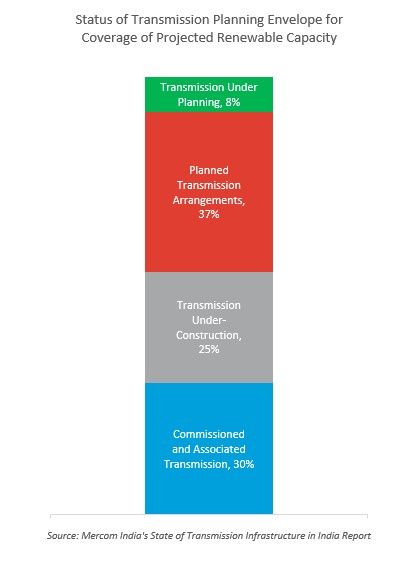
CEA’s FY36 planning envelope covers transmission infrastructure for about 16% more capacity than the projected renewable capacity in the base case. However, nearly 45% of the transmission required under the planning envelope is still planned or under planning stages, making timely commissioning the key risk.
India’s generation fleet is expected to expand significantly over the coming decade. Total installed generation capacity is projected to reach approximately 811 GW by FY31 and 1,121 GW by FY36, while renewable capacity is expected to increase to around 501 GW and 786 GW, respectively. The transmission system needs to accommodate substantially larger power flows, particularly from renewable-rich regions where generation is concentrated.
Integrating more than 500 GW of non-fossil capacity by 2030 will require about 51,000 ckm of additional interstate transmission lines and 434 GVA of transformation capacity, while interregional transfer capability is expected to rise to about 150 GW. Between FY27 and FY36, integrating incremental wind and solar capacity will require approximately 137,500 ckm of interstate and intrastate transmission lines and 828 GVA of transformation capacity.
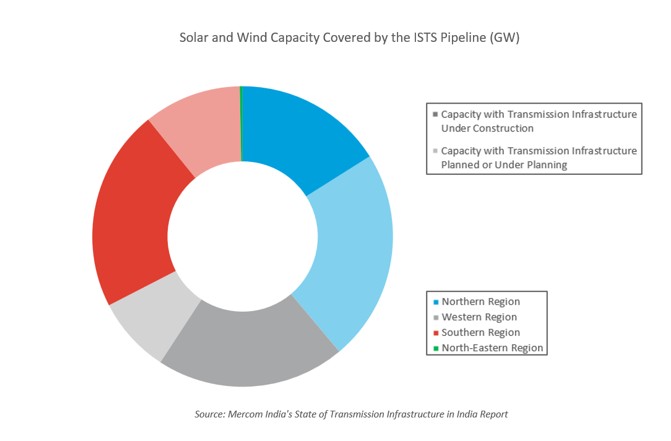
A significant portion of this requirement is already under development. Over 56,000 ckm of transmission lines and 338 GVA of transformation capacity were under construction through FY30.
The government and transmission agencies are also expanding investment in infrastructure for renewable evacuation. Green Energy Corridor (GEC) Phase I and Phase II had together commissioned approximately 10,254 ckm of transmission lines and 29,020 MVA of transformation capacity by June 2026. GEC Phase III, approved in September 2026, is further designed to support the integration of up to 135 GW of renewable capacity and includes 50 GWh of battery energy storage.
Between April 2025 and June 2026, 116 transmission tenders were issued, including 78 interstate and 37 intrastate projects. During the same period, 35 projects were awarded through competitive bidding, with POWERGRID securing 13. The growing use of competitive bidding is also increasing private-sector participation in transmission development.
India’s identified transmission investment requirement through 2035 could exceed ₹15 trillion (~$159 billion), including approximately ₹10 trillion (~$106 billion) for renewable integration. The buildout will drive demand not only for transmission lines, but also pooling stations, substations, transformers, reactors, GIS, high-capacity conductors, HVDC equipment, STATCOMs, protection systems, and digital substations. At the same time, simultaneous project development could strain equipment supply, particularly for components with long manufacturing lead times or import dependence.
Renewable projects can be developed faster than major transmission infrastructure, increasing the risk of generation capacity becoming ready before the required evacuation network.
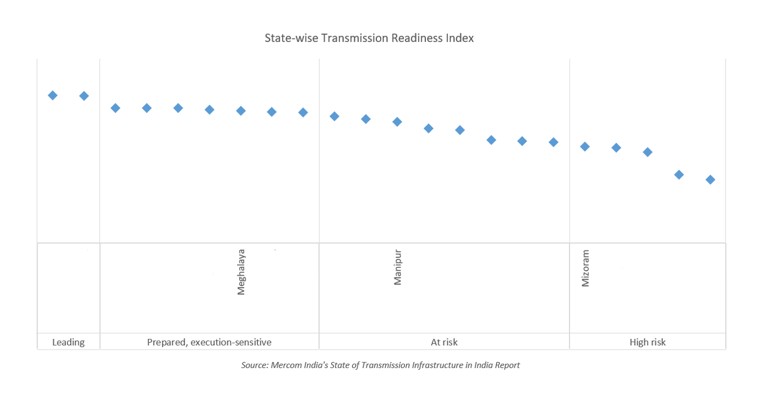
Transmission readiness also varies significantly by state. Mercom’s State-wise Transmission Readiness Index places two states in the leading category, while Mizoram and 4 other states fall within the high-risk category. Rajasthan, Gujarat, and a few other leading renewable installation-heavy states were also identified as having very high conditional curtailment exposure if critical transmission and grid-strengthening projects are delayed.
Key Highlights from Mercom’s State of Transmission Infrastructure in India Report:
- Nearly 45% of the transmission required under the FY36 planning envelope remains planned or under planning
- India had 509,603 ckm of transmission lines and 1,478 GVA of transformation capacity as of June 2026
- Over 56,000 ckm and 338 GVA were under construction through FY30
- Over 102,000 ckm and 891 GVA were planned or under planning through FY35
- Mercom’s State-wise Transmission Readiness Index identifies significant differences in transmission preparedness across states
Contact Mercom for pricing: reports@mercomindia.com or call us at +91-80-41211148.
Clean EnergyResearch Reports
Mercom India Research delivers in-depth market reports, that includes Proprietary data intelligence across the clean energy sector.
Other Reports
Custom Research & Consulting
Do you need more tailored research that cannot be answered by any of Mercom’s popular reports?
Our custom research services may be the answer.
We provide data and analysis to help companies understand information specific to their particular segment so they can make sound strategic decisions relating to new market entry, product introductions, or to simply help them understand how they or their customers are positioned within the market.
Mercom’s custom research and advisory services provide clients data and analysis tailored to meet their unique needs. Call us today to learn more: research@mercomindia.com